Service
Knowledge Graph
The Creaminds Knowledge Graph structures knowledge as a graph of nodes and relationships — research, analyze, curate, AI-assisted. Hosted or self-hosted inside your own network.
Knowledge as a graph — research, analyze, curate
The Creaminds Knowledge Graph structures knowledge as a graph of nodes and relationships: visible, searchable, extensible. AI-assisted extraction proposes content, you stay in control — every AI output passes through an approval step before it is committed.
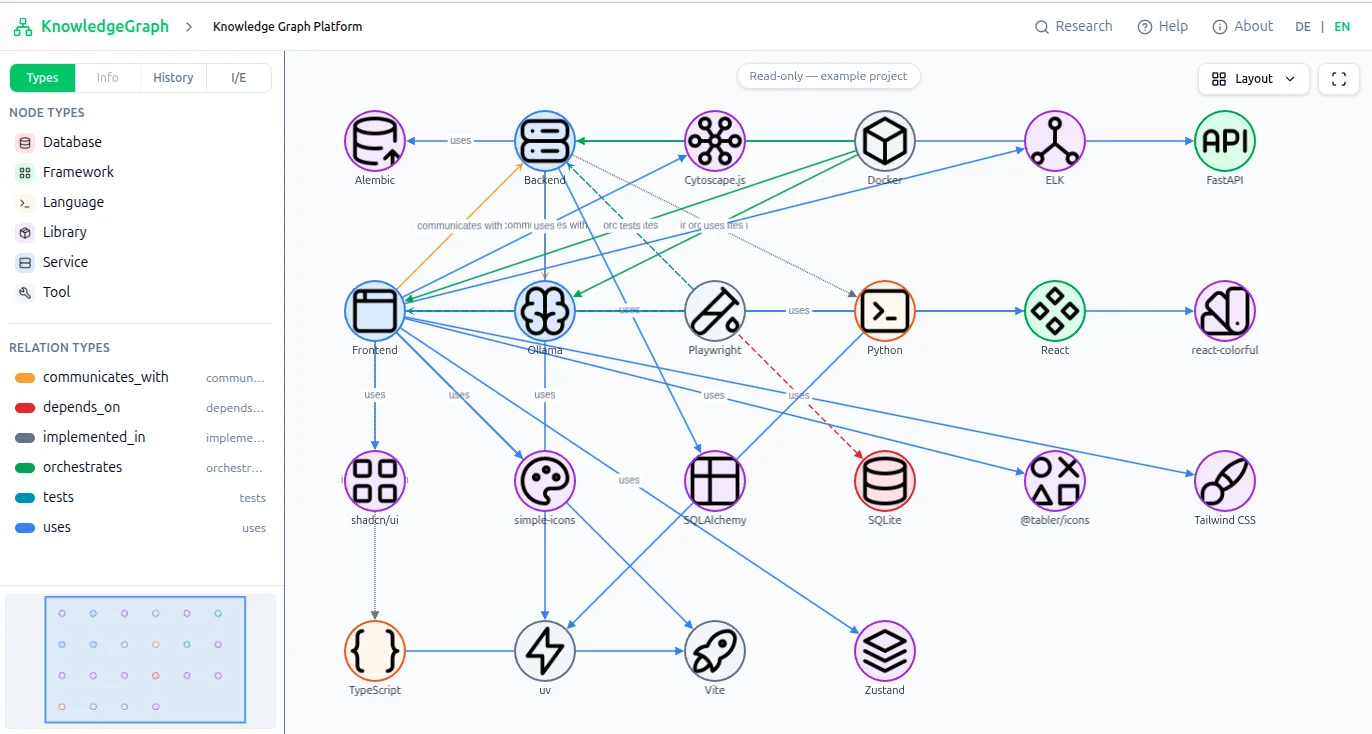
As a knowledge tool (available today)
- Research mode. You enter a topic; the model researches and proposes nodes and relationships — as a starting point, not a final state.
- Document review. You upload a document (PDF, text); the model extracts entities and relationships from it.
- Manual curation. Maintain nodes and edges by hand. AI suggestions land as drafts (staging) first and are committed only after your approval.
- Projects, teams, roles. Separate projects, access control, and roles for collaboration.
- Export. The active graph as JSON-LD (primary), CSV, or image (PNG/SVG).
Typical use: researching and analyzing complex topics, building structured knowledge, turning document collections into a navigable web of relationships.
Outlook: a visualization layer for G-Brain (planned)
G-Brain is our AI-maintained knowledge memory — capable, but without an interface of its own (headless). Planned is to place the Knowledge Graph on top of it as a visual exploration and governance layer: making G-Brain's knowledge visible and navigable, complemented by multi-tenant, team, and approval features. This extension is in planning and not yet part of today's product.
Deployment: hosted or self-hosted
- Hosted. Operated by Creaminds, ready to use, no infrastructure of your own.
- Self-hosted. An installable bundle (single-node Docker Compose, no Kubernetes) to run inside your own network — air-gapped (fully offline, model in the bundle) or connected (model pull on start, automatic TLS). Built-in user management (bundled Keycloak) or integration with your OIDC provider. SBOM and license notices included. Builds on our LLM self-hosting foundation.
Data sovereignty by construction
In self-hosting, all AI inference runs locally on an embedded open-source model (Qwen2.5, Apache-2.0) on your GPU — no cloud GPU, no external API keys. Credentials are generated locally at install time; in air-gapped mode with no internet access at all. This preserves the auditable data-flow boundary that GDPR, NIS2, CRA, or ISO 27001 require.
Requirements (self-hosting)
- A GPU-capable machine: NVIDIA GPU from 12 GB (24 GB recommended, e.g. A10G), ~100 GB disk.
- A domain for the service and Docker on the host.
- Cloud (e.g. an AWS GPU instance) or on-premises — your choice.
Who it is for
Organizations that want to structure and analyze knowledge — from individual research to a collaborative team knowledge graph. And those with strong data-residency requirements that want to run it inside their own network without a cloud dependency.